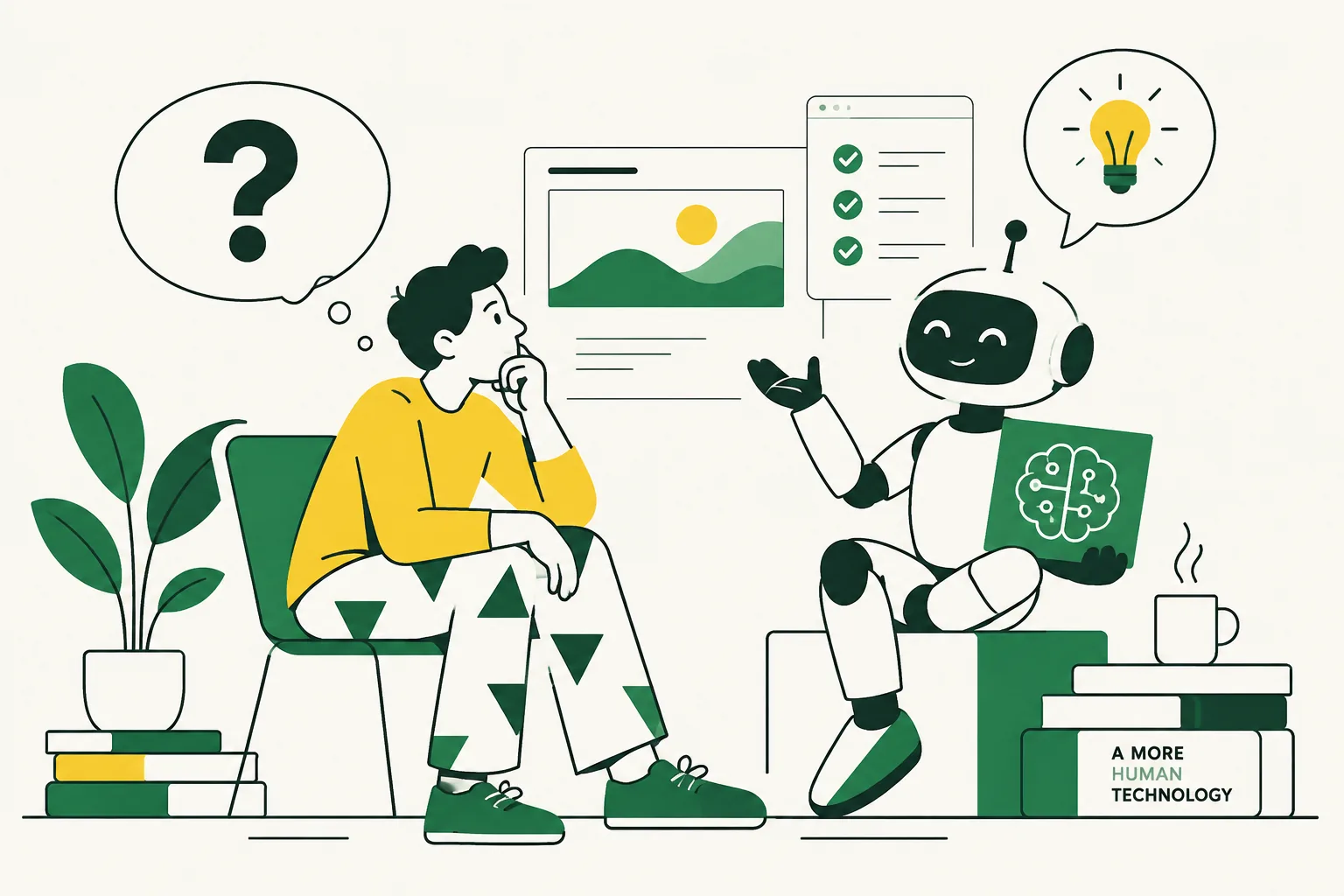
Millions of pieces of data, information and solutions are now within our reach every day. With AI, we can do almost anything: learn languages, have a lawyer in our pocket, write lengthy academic texts in just two minutes, and much more.
But there is something I have noticed during my experience with artificial intelligence.
Without a sufficient understanding of how AI works and how to develop effective prompts — the instructions we give to artificial intelligence — we risk using it in the wrong way.
The problem is not necessarily that AI makes us less intelligent. The problem is that it could become a substitute for our own reasoning instead of a tool that enhances it.
If AI can give us an answer to almost anything, what happens to our ability to reach that answer on our own?
The problem with AI isn't the technology, but how we use it
Artificial intelligence is a tool. And, as with any tool, its impact also depends on how we choose to use it.
We can use AI to speed up a task we already know how to perform. We can use it to compare two ideas, identify a weakness in an argument, explore a possibility we hadn't considered, or help us organise complex information.
But we can also use it as a shortcut. In this case, the problem isn't the answer we receive, but the thinking process we stop going through to reach it.
When the answer comes before the reasoning
Imagine a child who has not yet developed a sufficient understanding of AI and starts interacting with an artificial intelligence system.
The first question might be very simple: "What is 5 × 5?"
The system immediately responds: 25.
The answer is correct. But if that child gets used to relying on an external source every time they need to solve a problem, there is a risk that they will start skipping the most important step: trying to reason things out.
Of course, a single interaction with AI does not change the way someone thinks. The real issue is the habit that develops over time.
If every question automatically becomes a prompt, we may gradually start treating reasoning as an unnecessary step.
Are we adults really doing anything differently?
Probably not always.
We ask AI to write an email before we've even decided what we want to say. We ask it to summarise a document before reading it. We ask it to generate ideas before trying to develop one ourselves.
And often, there's nothing wrong with that. The problem arises when technology stops being a support tool and becomes the starting point of our thinking process.
In other words: we no longer use AI after thinking. We think through AI.
The real difference isn't between those who use AI and those who don't. It's between those who use it to replace their own reasoning and those who use it to make their thinking more effective.
AI as a replacement or an amplifier?
We can imagine two very different approaches.
AI as a replacement
Problem → prompt → answer → done.
In this scenario, the user delegates to AI not only the generation of the answer, but also much of the process that should lead them to formulate and evaluate that answer.
AI as an amplifier
Problem → reasoning → prompt → comparison → refinement → better solution.
Here, AI becomes a tool to think alongside. It can challenge an idea, highlight a mistake, suggest an alternative or help develop something we have already started building.
The difference may seem subtle, but it completely changes the role of technology.
We don't need to know everything. We need to know what to ask.
One of the paradoxes of AI is that the more information we have available, the more important it becomes to know how to ask the right questions.
A prompt is not just a sentence typed into a text box. To get a useful answer, we need to understand, at least to some extent, the problem we are trying to solve.
We need to know what information to provide, what result we want to achieve and, above all, whether the answer we receive actually makes sense.
This means that understanding the subject still matters. AI can generate an answer, but we are the ones who must decide whether that answer is accurate, useful and appropriate for the context.
So, do we really need AI?
The answer is probably yes. But perhaps we should be asking a better question.
We shouldn't only ask ourselves whether we need artificial intelligence. We should ask what we want to use it for.
If we use it to avoid thinking, we risk delegating an increasingly large part of our decision-making process to an external tool.
If, instead, we use it to challenge our ideas, expand our capabilities, analyse more information and work faster, its value changes completely.
Perhaps, then, we don't have to choose between "using AI" and "not using AI".
We need to learn how to use it without forgetting how to reach an answer ourselves, even when AI isn't there to provide one.
Want to explore AI for your business?
Grapesbyte helps organisations explore AI automation, digital workflows and smarter ways to manage social media operations.
Get in touch →